Why “Connected Workforce” Models Often Miss the Point
Over the last few years, connected workforce has become a popular promise in manufacturing software. The idea is straightforward: give operators a way to message, post photos, and share updates in real time, and collaboration will improve. Problems will surface faster. Decisions will happen sooner.
That’s the theory.
What often happens on the shop floor looks different.
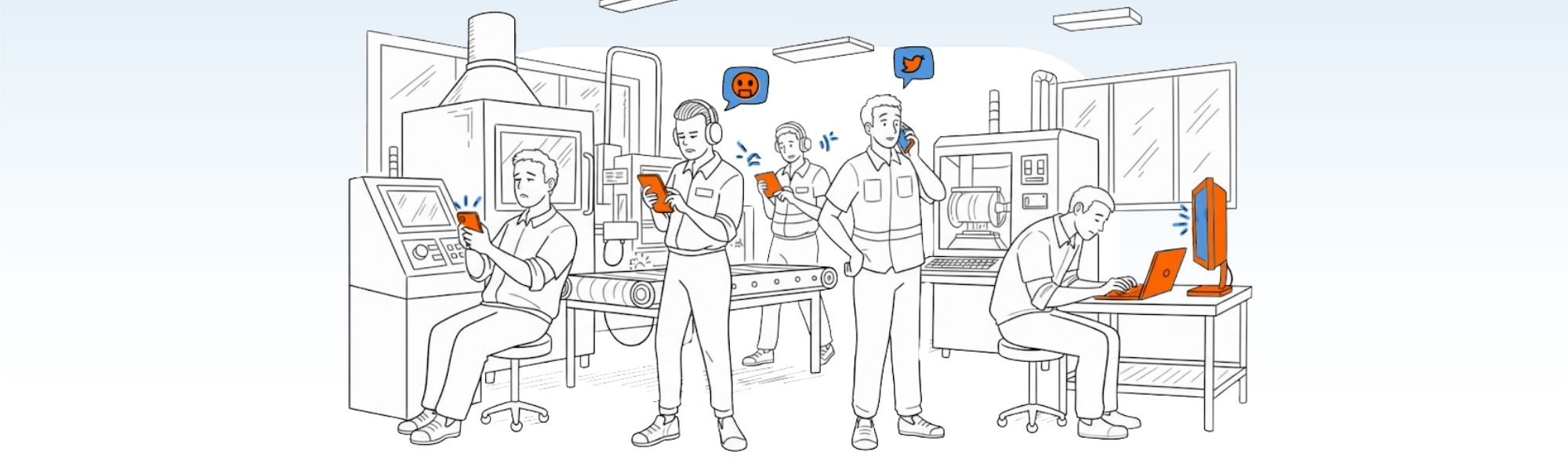
More communication doesn’t automatically improve execution. In many plants, it creates a new layer of noise—activity without direction, visibility without ownership. Messages increase, but clarity doesn’t. People stay busy, but the same issues keep coming back.
Most connected workforce tools are built on a social model. Open posts. Free-form comments. Constant interaction. That model works when the goal is conversation. Manufacturing doesn’t run on conversation. It runs on priorities, constraints, and follow-through.
When communication isn’t structured, a few predictable things happen. Important signals get buried in volume. Problems get reported faster, but they don’t land with clear responsibility. Supervisors spend more time sorting messages than fixing problems. Leaders inherit more information, but less certainty about what actually needs to change.
The organization feels more “connected,” but execution gets harder.
From a Lean perspective, this is a problem. Lean depends on standard work and disciplined problem-solving. Ad-hoc communication cuts around those systems. Instead of reinforcing process, it bypasses it. Instead of helping teams learn, it creates running commentary. Root causes get replaced with opinions. Priorities blur. Attention scatters.
That isn’t improvement. It’s entropy.
None of this means operator input isn’t valuable. It is. Operators see things long before dashboards do. The mistake is assuming that giving people more ways to talk automatically turns insight into action.
It doesn’t.
When voice isn’t tied to a system, the burden shifts downstream. Supervisors chase context. Managers interpret intent. Leaders absorb noise. What looks like empowerment often becomes another form of waste—one more thing that relies on heroic effort to manage.
This is why we take a different position at Flex. We believe the most important connection, and the one that ultimately unifies an operation, is the connection between people and process. Communication should support execution, not compete with it. Operator input should function as operational signal—structured, contextual, and actionable—not as conversation.
When voice is handled this way, it does real work. It clarifies priorities. It reinforces discipline. It creates follow-through instead of accumulation.
That’s the difference in focus. Connected workforce platforms optimize for more communication. Flex optimizes for better execution. Where others increase volume, we work to increase signal. Where others surface issues, we work to ensure ownership. Where others create activity, we focus on building capability.
As we continue developing the Voice of the Operator, we’re being intentional about how it works—not just what it captures. The goal isn’t to make it easier to talk. It’s to make it easier to provide useful context, and harder to create noise. Because the way people are asked to communicate shapes how they think, how leaders respond, and whether insight actually turns into improvement.
If you’ll be at PACK EXPO East 2026, we’ll be demoing a public preview of our evolving Voice of the Operator experience. If you’re attending, stop by. We’d welcome the chance to walk through it and hear your perspective on where shop-floor communication helps—and where it gets in the way.
Booth 958: https://bit.ly/3MdRL4x